
Celebrating IYC and ICU 2025 with the Credit Union Movement in Indonesia
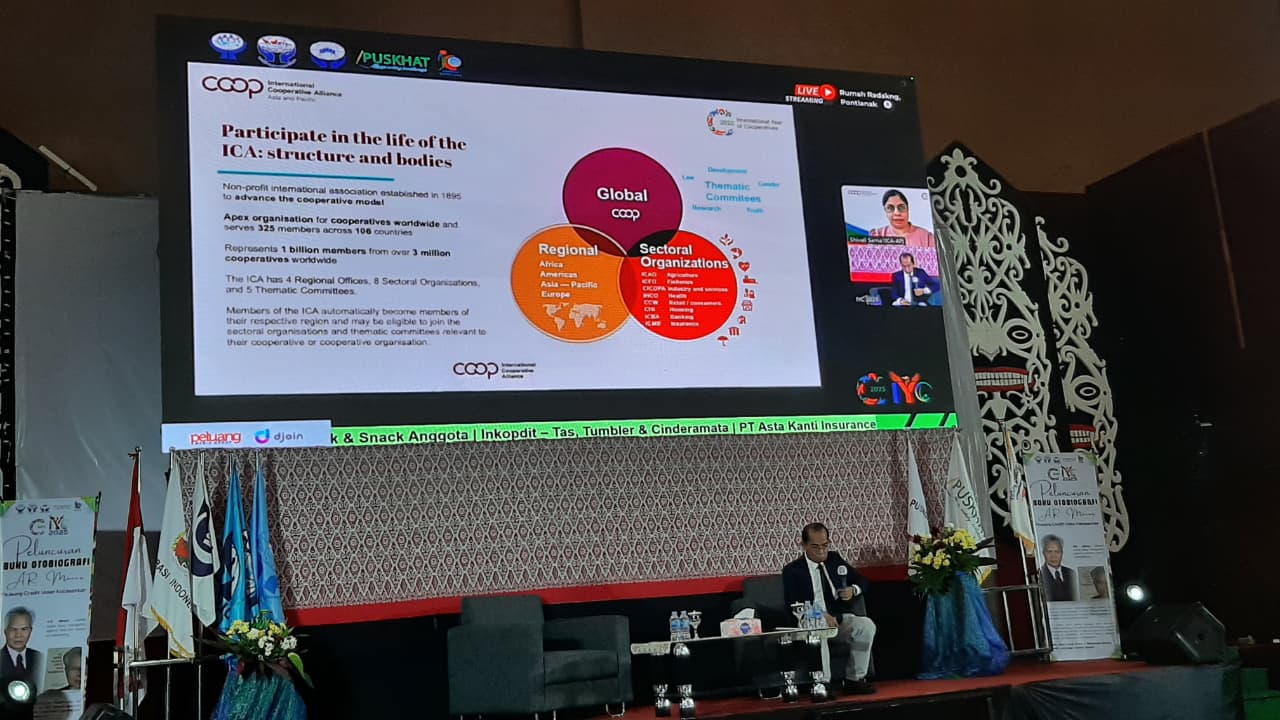
The joint commemoration of the International Year of Cooperatives (IYC) and International Credit Union (ICU) Day 2025 in West Kalimantan, on 18 October 2025, brought together leaders, members, and partners of the cooperative movement to reaffirm shared values and collective purpose. While the celebration acknowledged the achievements of the credit union sector in the region, the ICA-AP Regional Office was invited to deliver a keynote lecture during the international seminar session on “Cooperatives Build a Better World.”
Ms. Shivali Sarna, Lead – Communications and Membership Development at ICA-AP, centered her lecture on the foundation of the cooperative identity and its continued relevance in today’s fast-changing world, the significance of the second IYC, highlights of how cooperatives in the Asia-Pacific region are building a better world, and the credit & banking cooperatives in the region.
Ms. Sarna began by grounding the discussion in the Cooperative Identity, which defines what makes cooperatives distinct. She explained that this identity is built on values such as self-help, democratic participation, equality, and solidarity. These values guide how cooperatives organize, make decisions, and serve their members. She emphasized that understanding and practicing these values is vital, especially as cooperatives navigate modern-day challenges and opportunities. Discussing the ongoing global consultation on the Cooperative Identity, she invited the Indonesian leaders and members to take part in this global dialogue so that their experiences and perspectives contribute to shaping the future direction of the movement.
Her presentation explained why the second IYC in 2025 holds such importance. She highlighted three key reasons. First, cooperatives are increasingly recognized as engines of inclusive economic growth that distribute benefits fairly among members. Second, cooperatives have shown strong contributions to achieving the Sustainable Development Goals, especially in areas like gender equality, decent work, and community wellbeing. Third, cooperatives have demonstrated the ability to adapt in times of crisis and uncertainty, offering resilient solutions to issues such as inequality, climate risks, and social fragmentation.
Ms. Sarna also shared a snapshot of how countries across the Asia-Pacific region are celebrating IYC 2025. Four national committees have been formed in Australia, Iran, Jordan, and Saudi Arabia. Eleven countries have already held large national-level events. Governments in Japan, Fiji, China, Saudi Arabia, Australia, Jordan, and many other countries have recognized and supported cooperatives through updated policies and laws. Creative campaigns have emerged as well, such as Australia’s BCCM Icons campaign, the cooperative anthem in Nepal, postage stamps in India and Jordan, and IYC promotions through Amul milk and Bharat Organic product packaging, railway tickets in India, and the public display of the UN Secretary General’s message in the metro network in the Philippines, etc.
Illustrating how cooperatives are building a better world, she shared practical examples across the region. Some cooperatives strengthen the economy by providing stable markets and livelihoods. Others create social value by empowering women, people with disabilities, and youth. Many are promoting environmental sustainability by encouraging responsible production and land use. Several cooperatives are also advancing inclusivity by ensuring marginalized groups have a voice and opportunities for leadership.
Her presentation also focused on the credit and banking cooperatives ecosystem in the region and the CU movement in Indonesia. She described the CU movement as the “heartbeat of the Indonesian cooperative movement,” known for its community-based approach and education-driven empowerment. She recognized CU Lantang Tipo for its large outreach and strong governance, Pancur Kasih Credit Union for its integration of cultural values and community development, and PUSKOPCUINA for leading digital transformation that makes cooperative services more accessible and efficient. These examples were presented as models of community-owned finance rooted in trust, participation, and shared progress.
Ms. Sarna noted that governments across Asia and the Pacific are publicly acknowledging the role cooperatives play in national development. She showcased two videos that demonstrated how cooperatives support people in their everyday lives and how the ICA is sharing these stories globally.
She concluded by encouraging continued collaboration, stronger engagement in the cooperative identity consultation, and sharing more and more stories of cooperatives building a more inclusive and hopeful future.