
Breaking the Glass Ceiling: New ICA-AP Report Demands Strategic Leadership Roles for Women in Asia-Pacific Cooperatives
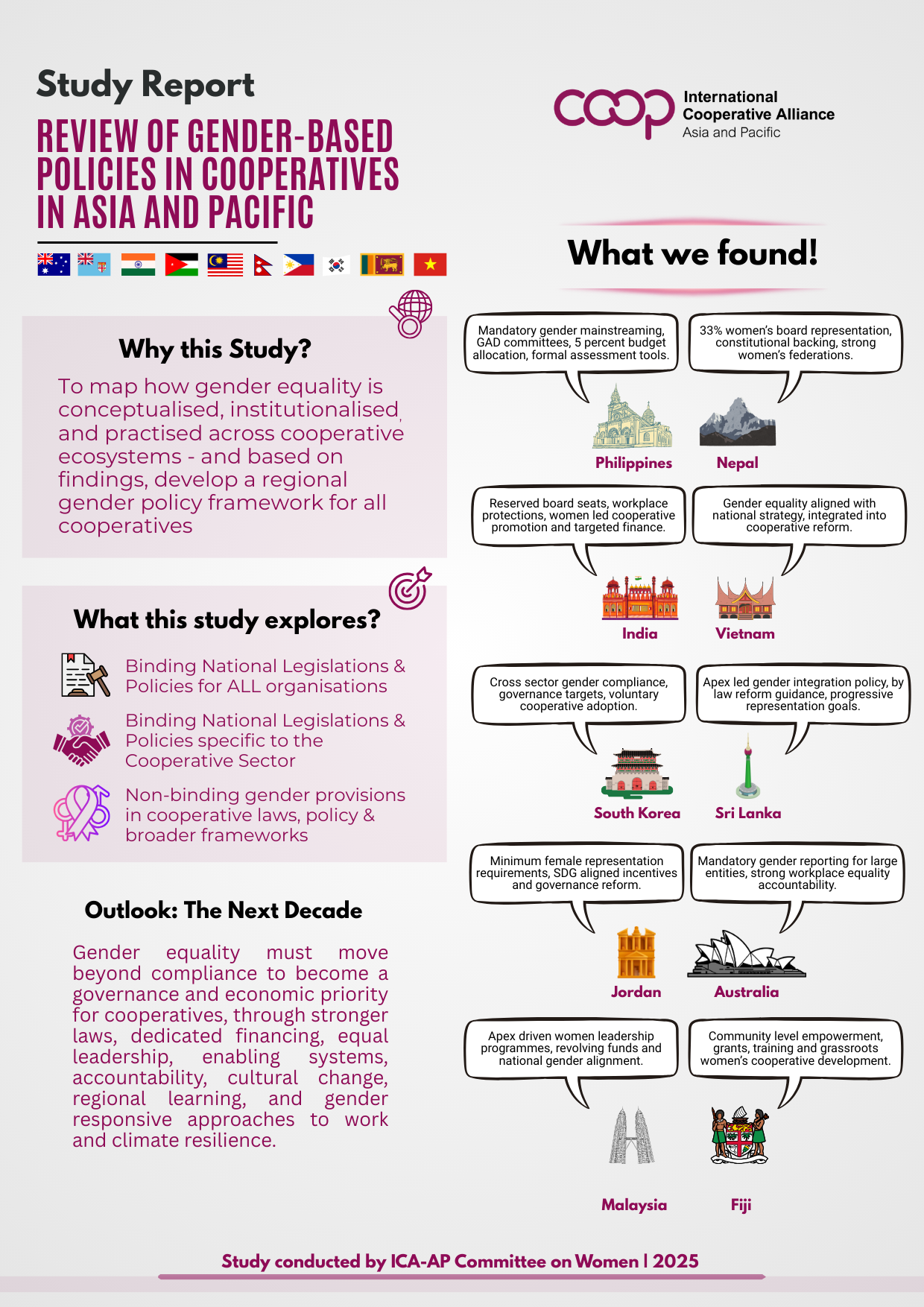
The International Cooperative Alliance – Asia and Pacific (ICA-AP)Committee on Women has released its study, “Review of Gender-Based Policies in Cooperatives in Asia-Pacific Countries,” which examines how gender equality is addressed across cooperative systems in Australia, Fiji, India, Jordan, Malaysia, Nepal, the Philippines, South Korea, Sri Lanka, and Vietnam. This landmark report provides a thorough analysis of the systemic gender gap, identifying why, despite rising membership numbers, women remain significantly underrepresented in senior governance and how a transition from voluntary guidelines to binding legislative mandates is the only viable path to achieving genuine equity. By investigating the intersection of national laws and institutional practices across these ten countries the study explains that the “participation-leadership gap” can only be closed through enforceable accountability mechanisms that empower women to move from mere presence to influential leadership within the world’s most democratic business model.
The research demonstrates how structural barriers, such as the disproportionate burden of unpaid care work and systemic financial exclusion, continue to stifle women’s advancement, necessitating a radical shift in regional policy strategy for the 2026–2030 period. To rectify this, the report highlights successful “Gold Standard” models like the Philippines’ mandatory Gender and Development (GAD) budgets and Nepal’s statutory 33% leadership quotas, illustrating how specific legal requirements can dismantle patriarchal norms more effectively than the non-binding appeals currently favoured in countries like India, Australia, and Malaysia. By synthesizing these diverse regional experiences, from burgeoning women-led movements in Jordan and Fiji to the institutionalized support systems in South Korea, Vietnam, and Sri Lanka, ICA-AP provides a clear, narrative-driven roadmap to institutionalize gender-responsive financing and digital literacy, ensuring that the cooperative movement thrives as a truly inclusive driver of sustainable development and economic prosperity for all its members
.
The Narrative of Change: From Presence to Influence
The report’s narrative unfolds across a spectrum of progress. In the Philippines, the institutionalization of equality is not just an ideal but a financial requirement, where cooperatives are legally mandated to allocate 5% of their funds toward gender sensitivity and development. This contrasts with the experiences in nations like India and Malaysia, where while the spirit of inclusion is strong and training programs are abundant, the lack of enforceable quotas often leaves women in secondary or “women-wing” roles. The study dives deep into the “time poverty” that plagues women in Fiji and Sri Lanka, where the dual burden of domestic labour and cooperative participation often limits their ability to seek executive office, suggesting that cooperatives must evolve to offer social services like childcare to truly level the playing field.
In the more industrialized cooperative sectors of South Korea and Australia, the challenge shifts toward breaking through the final corporate-style glass ceiling. Here, the report advocates for more rigorous gender auditing and transparent reporting to ensure that “inclusive culture” translates into executive power. Meanwhile, in Jordan and Vietnam, the focus remains on bridging the digital and financial divide, ensuring women have the technical skills and the “gendered trust” from credit institutions required to lead large-scale enterprises.