
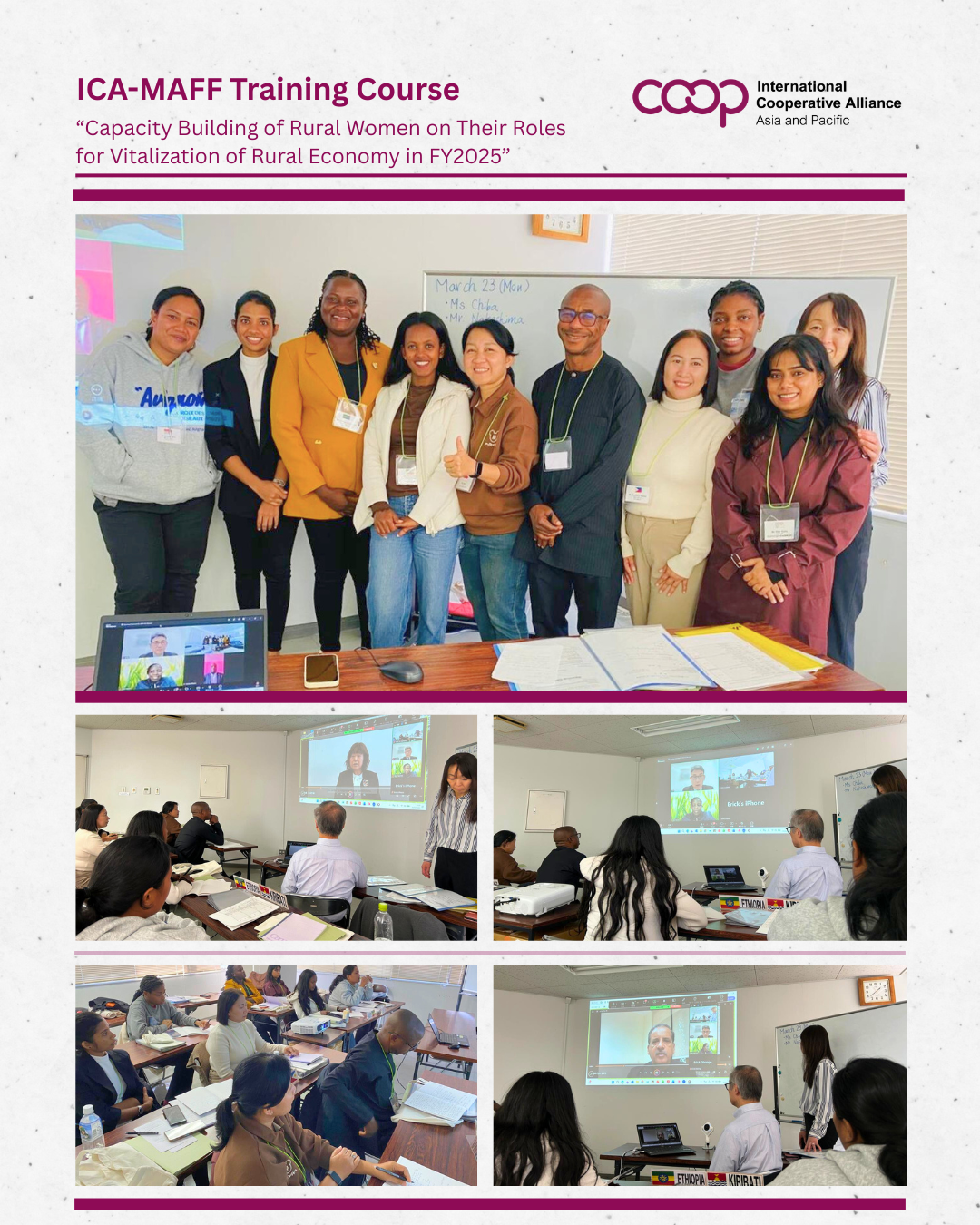
Capacity Building for Rural Women: ICA-MAFF Japan Training Course
The ICA-MAFF Japan Training Course on “Capacity Building of Rural Women on their Roles for Vitalization of Rural Economy in FY 2025” brought together seven participants from ICA member organisations across Indonesia, Kiribati, the Philippines, Sri Lanka, Ghana, Tanzania, and Ethiopia for an immersive learning experience in Japan.
The programme began with home country assignments from 16 to 22 March 2026, setting the context for each participant’s work, before moving into an intensive in-country training phase from 23 March to 3 April 2026. Organised in collaboration with the Institute for the Development of Agricultural Cooperation in Asia (IDACA) in Tokyo, and supported by the Ministry of Agriculture, Forestry and Fisheries (MAFF) of the Government of Japan, the course aimed to deepen understanding of women’s roles in rural economies and strengthen cooperative led approaches to entrepreneurship.
The training was thoughtfully designed, combining classroom discussions with field exposure and practical exercises. Early sessions focused on grounding participants in key concepts, reviewing preparatory assignments, and guiding them in shaping action plans that would later connect learning with real world application.
A standout feature of the programme was the series of field visits to Japanese agricultural cooperatives, including JA Saitama Chuo, JA Hagano, JA ZEN NOH, JA Tenno, and JA Kanagawa Seisho. These visits offered a close look at how cooperatives function in practice, from governance structures to member engagement and service delivery. Participants observed how systems for grading, packaging, storage, and direct sales contribute to stable incomes and stronger market linkages for farmers.
Equally impactful were interactions with women farmers. Visits to Ms. Kurishima and Ms. Ino provided grounded, personal insights into women led agricultural enterprises. At Ms. Ino’s YU Corporation, participants explored a diversified model that blends farming, Agro-processing, and Agro-tourism, including strawberry picking initiatives. These exchanges brought to life the role of leadership, collaboration, and community networks in sustaining rural enterprises.
The programme also included a meeting with the Mayor at Moka City Hall, offering a valuable governance perspective. Discussions highlighted how local institutions can actively support cooperatives and create enabling conditions for women farmers through policy support, partnerships, and community engagement.
Further learning came through visits to direct sales shops, showcasing effective farmer to consumer models, and sessions on education and capacity building that emphasised continuous learning and youth engagement. A case study on women in agriculture in Sudan and across Africa added a comparative lens, illustrating how small scale enterprises evolve in diverse and often challenging contexts.
What made the programme particularly meaningful was its balance. It did not simply present success stories, but created space for participants to reflect, question, and connect these experiences with realities back home. Across different regions and contexts, one idea remained constant, that strong cooperation, inclusive participation, and a commitment to learning are essential to building resilient and sustainable rural economies.