
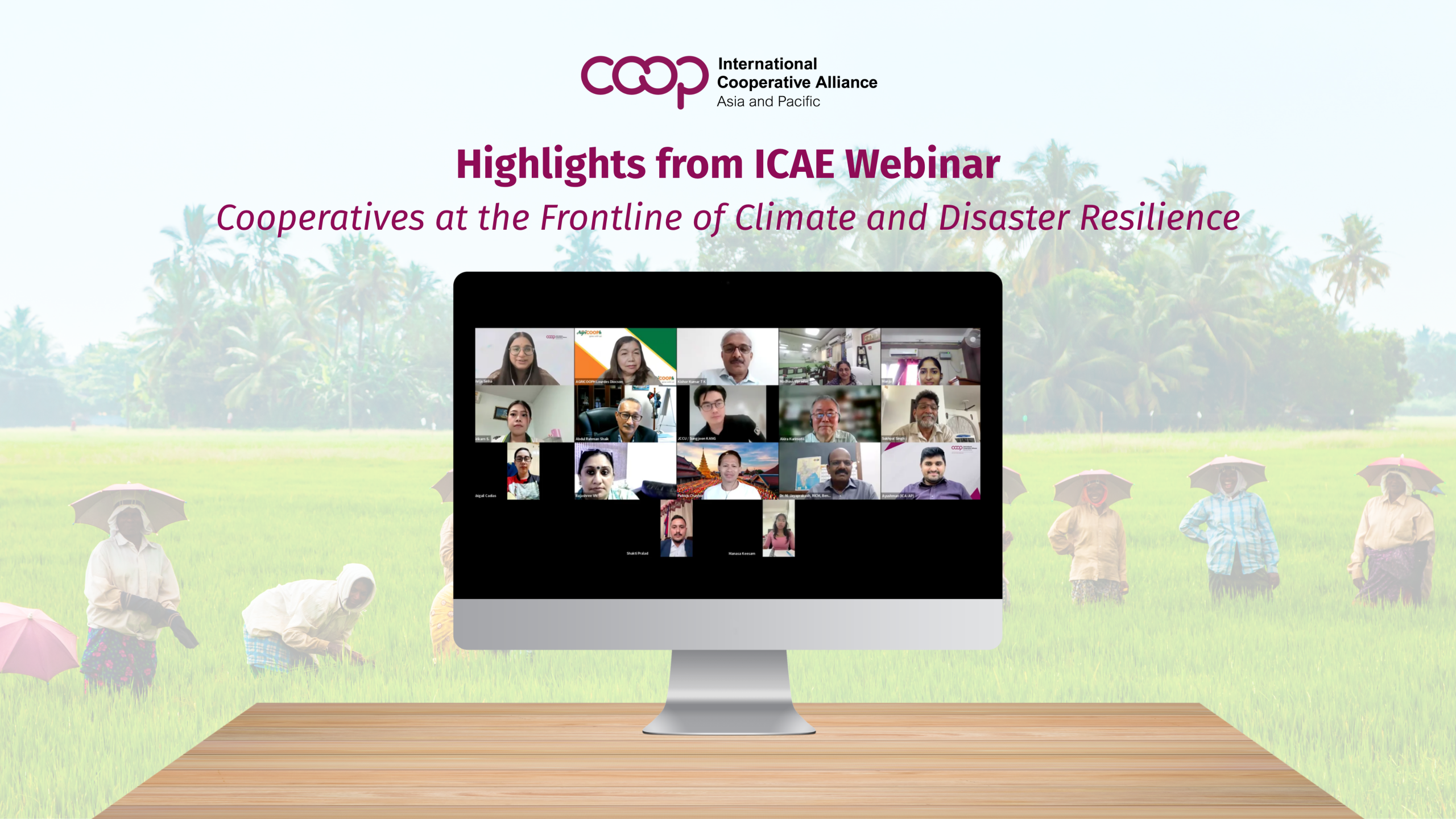
Webinar Highlights: Cooperatives at the Frontline of Climate and Disaster Resilience
The International Cooperative Alliance Asia and Pacific (ICA-AP), through its Committee on Agriculture and Environment (ICAE), organized a regional webinar on “Cooperatives at the Frontline of Climate and Disaster Resilience” on 19 May 2026. . The webinar brought together cooperative leaders, policymakers, researchers, and practitioners from across the Asia-Pacific region to discuss how cooperatives are responding to the growing impacts of climate change-induced disasters and strengthening community resilience.
The webinar was organised against the backdrop of increasing climate-related disasters across the Asia-Pacific region. As highlighted in the concept note, rising global temperatures and extreme weather events such as floods, cyclones, droughts, landslides, and sea-level rise are intensifying vulnerabilities and disrupting livelihoods across communities. The webinar aimed to document and showcase cooperative-led responses and resilience practices, strengthen understanding of disaster preparedness and climate risk management, and identify policy pathways to enhance long-term cooperative resilience.
Opening the session, Mr. Balu Iyer, Regional Director of ICA-AP, emphasized that cooperatives, rooted in principles of mutual support, collective action, and community solidarity, are uniquely positioned to support disaster preparedness, recovery, and climate adaptation at the grassroots level.
The first presentation featured Mr. Arun Baboo, Chief Operating Officer and Head of the Wayanad Rehabilitation Project at the Uralungal Labour Contract Cooperative Society (ULCCS), India. His presentation focused on the devastating Wayanad landslides of July 2024 and the cooperative-led rehabilitation efforts that followed. He highlighted the severe social, economic, and environmental impacts faced by affected communities, including displacement, livelihood losses, psychological trauma, and infrastructure destruction.
Mr. Baboo presented the Wayanad Integrated Township Project as a model of climate-resilient rehabilitation. The project aims to rehabilitate 410 affected families through permanent housing, resilient infrastructure, community facilities, sustainable wastewater treatment systems, renewable energy integration, biodiversity-sensitive planning, and disaster preparedness mechanisms. The presentation demonstrated how cooperatives can move beyond immediate relief to provide long-term, community-centered, and climate-adaptive rehabilitation solutions.
The second presentation was delivered by Mr. Akira Kurimoto, Senior Fellow of the Japan Cooperative Alliance, Japan, who shared lessons from Japanese cooperatives’ responses to the 1995 Kobe Earthquake and the 2011 East Japan Earthquake and Tsunami. He explained how consumer cooperatives, medical cooperatives, and national cooperative unions rapidly mobilized food supplies, fuel, healthcare services, volunteers, and emergency support for affected communities.
He also discussed the long-term institutional lessons that emerged from these disasters, including the development of business continuity planning (BCP), emergency supply agreements with local governments, strengthened inter-cooperation among cooperatives, and the establishment of resilient communication and backup systems. His presentation highlighted how cooperative solidarity and preparedness contributed significantly to disaster recovery and rehabilitation in Japan.
The third presentation was delivered by Ms. Lourdes F. Diocson, Project Lead of AgriCOOPh, Philippines, who discussed the growing climate vulnerabilities faced by the Philippines, including typhoons, floods, sea-level rise, coastal erosion, droughts, and biodiversity loss. She highlighted how agricultural cooperatives are strengthening resilience among farming and fishing communities through climate-smart agriculture, disaster risk reduction and climate change adaptation (DRR-CCA) trainings, participatory coastal resource assessments, and nature-based solutions.
Special emphasis was given to the CGRASS Project, which promotes seagrass restoration and sustainable sea cucumber farming as nature-based approaches for biodiversity conservation, livelihood protection, and coastal resilience. Ms. Diocson also presented AgriCOOPh’s Climate Resilience Mechanism (CRM), which supports climate-responsive financing, disaster response funds, renewable energy initiatives, agroecology, and sustainable agricultural development for member cooperatives.
The final presentation was delivered by Dr. Sukhpal Singh, Professor at the Indian Institute of Management Ahmedabad, who focused on policy pathways for strengthening cooperative resilience in the face of climate change-induced disasters. He explained that cooperatives are inherently resilient due to their democratic governance structures, principles of solidarity, social inclusion, and strong community engagement.
Dr. Singh emphasized that cooperatives play a crucial role in climate adaptation through access to markets, credit services, sustainable agriculture initiatives, and community-level disaster responses. He stressed the need for enabling legislation, financial support, technical assistance, preferential procurement policies, and institutional capacity-building to strengthen cooperative resilience and ensure inclusive and sustainable development. He also highlighted the importance of decentralized approaches that consider local socio-economic and environmental realities.
Prof. Datuk Dr. Abdul Rahman Razak Shaik, Chair of ICAE (ANGKASA Malaysia), delivered the vote of thanks. The webinar successfully showcased how cooperatives across the Asia-Pacific region are emerging as key actors in disaster preparedness, rehabilitation, climate adaptation, and sustainable community development.
Watch the full webinar: Here