
Six Countries, One Question: What Should It Mean to Be a Cooperative?
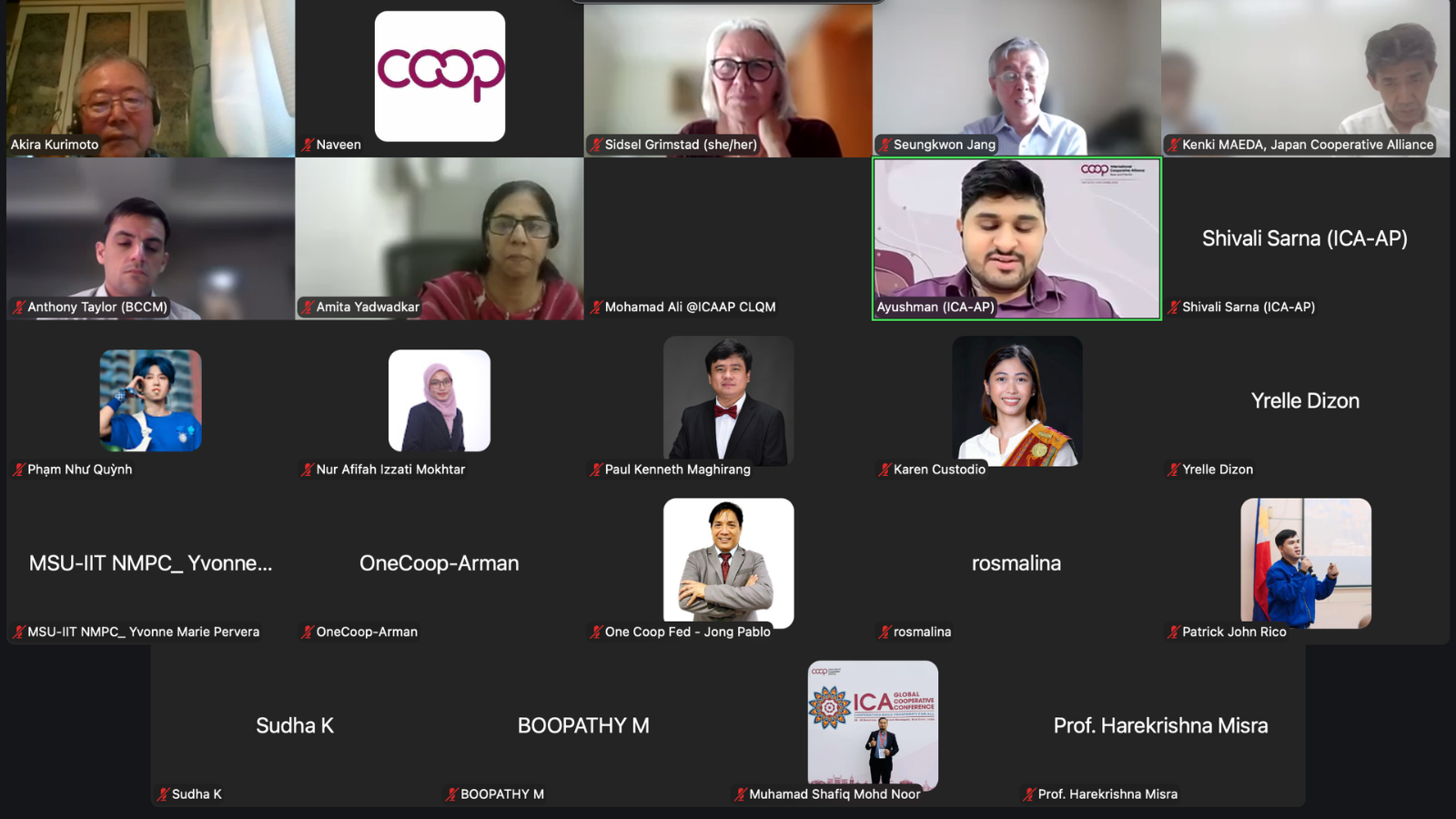
Coop Colloquium 18, hosted by ICA-AP’s Committee on Cooperative Research on July 28, 2026, brought cooperative leaders, academics and practitioners from across the region onto one webinar, to debate Discussion Draft 3 (DD3) of the ICA Statement on Cooperative Identity, the document that defines what a cooperative is and how it should be governed. Speakers from Korea, India, the Philippines, Indonesia, Japan and Australia broadly backed the direction of DD3, but not without pointed concerns, ranging from legal risk to youth inclusion to innovation.
Mr. Balu Iyer, ICA-AP’s Regional Director, opened by framing the stakes: if the Rochdale Pioneers’ principles could outlast the Industrial Revolution, can they guide cooperatives through the age of AI too? Prof. Akira Kurimoto of the Cooperative Identity Advisory Group then traced the Statement’s long arc, from the Rochdale rulebook of 1844, through the 1937 and 1966 principle revisions, to the 1995 Manchester Congress that produced today’s version, and on to the consultation launched at Seoul in 2021 that has produced three discussion drafts since.
DD3’s changes are more than wording. It adds a preamble for the first time, updates “self-help” to “mutual self-help” and folds environmental and economic language into Principle 7, the Statement’s social responsibility principle. The sharpest debate centered on Principle 3, Member Economic Participation, where DD3 introduces “usership,” recognizing members who use or produce a cooperative’s services, not just those who invest capital. Principle 5 would become “Public Promotion” instead of “Information,” and Principle 7 would expand from “Concern for Community” to “Commitment to Sustainable Communities,” moving the lens from local to global.
The most consequential caution came from Dr. Ann Apps of the ICA Cooperative Law Committee. The 1995 Statement is already written into ILO Recommendation 193, UN guidelines and the laws of at least 117 member states, she noted, so revising it doesn’t erase the old text, it creates two competing versions in circulation at once. Her line in the sand: wording clarifications belong in guidance notes, which are persuasive but not legally binding; anything that changes meaning needs to clearly justify the confusion two versions would cause.
Each region added its own thread. Korea pushed to fold in the Social and Solidarity Economy, backed by a decade of legislative momentum at home. India warned that its cooperative sector is too vast and varied for one national reading, and asked for simpler, multilingual guidance notes released alongside the Statement, not decades later as happened in 1995. The Philippines wanted youth woven into every principle, not confined to education, plus clearer language on disaster resilience. Indonesia argued for “innovation” to be added to Principle 5, or made an eighth principle outright, warning that movements stagnate without it. Japan, drawing on a two-year, 42-workshop, 2,300-participant national consultation, backed the Principle 7 changes given its shrinking rural communities, while pressing for guidance on what “active participation” means beyond voting. Australia called for indivisible reserves language, dropped in DD2, to return to Principle 3 to keep cooperatives distinct from other social enterprises.
Submissions on DD3 closed 31 July, with guidance notes on digital transformation and AI now being drafted under monthly review by CIAG. The Special Committee is due to submit final drafts to the ICA Board in 2027, ahead of a targeted vote at the ICA Congress in 2028.
Watch the VOD here