
Boundaries Are Not Walls: Committee on Women Learns to Lead Without Losing Itself
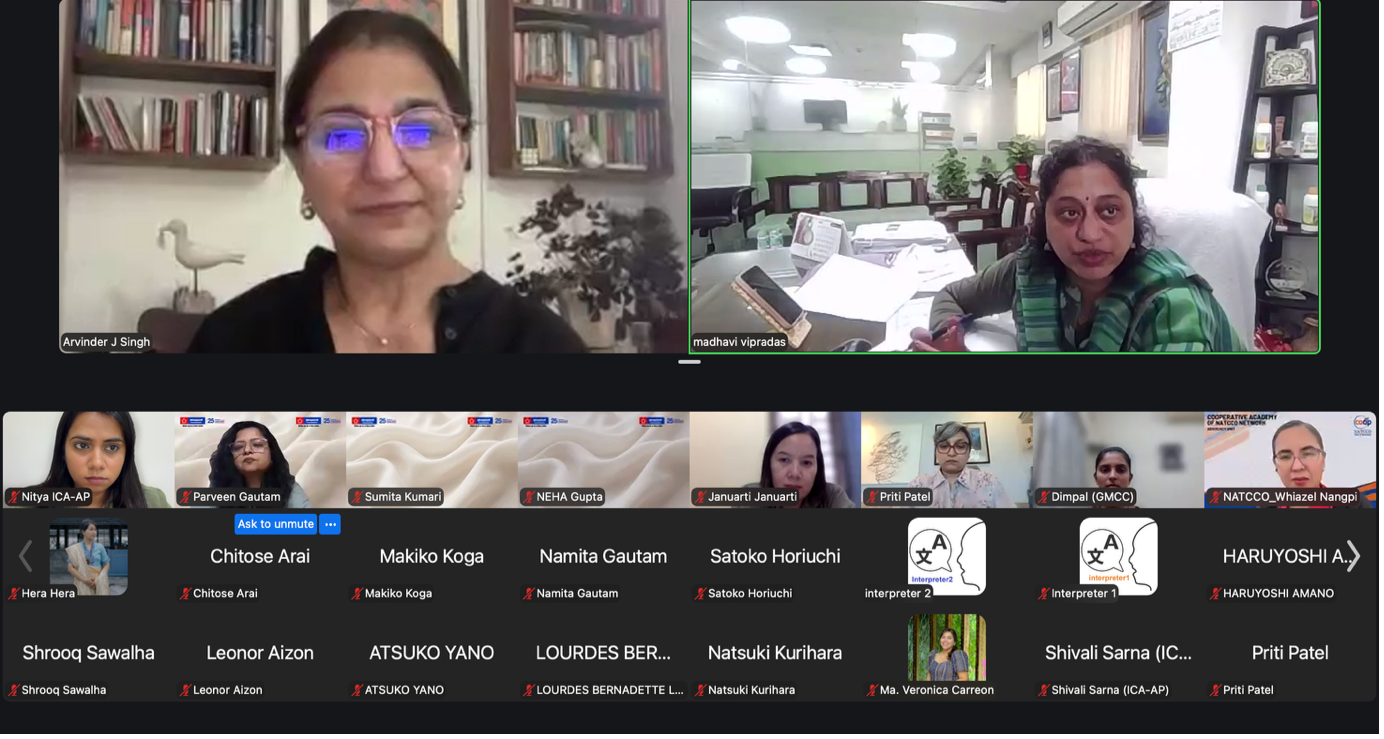
“The measure of leadership is not how much of ourselves we are willing to give away, but how effectively we bring ourselves to work.” With this thought, psychologist and psychotherapist Ms. Arvinder J. Singh led members of the ICA-AP Committee on Women through a lively online workshop on 21 October 2026. It was the third year the Committee has run the series with the Sleepwell Foundation, and this edition gave women cooperative leaders practical ways to protect their time, energy and voice.
Ms. Singh, founder-director of the Ashoka Centre for Well-being at Ashoka University, began by naming the hidden costs of weak boundaries: cognitive overload, emotional exhaustion, and the resentment that builds when we say yes but mean no. Over time, she said, leaders slip from strategy into day-to-day management. A leader should sit “on the treetop”, watching for roadblocks ahead. She asked members to think about what truly needs their attention right away, and what is simply a habit of always being available.
When she asked members to picture a boundary, most saw a wall. Ms. Singh offered another image: a hedge of flowers. It is open and welcoming and can be moved when someone is truly in need, yet it still marks one’s own space. She introduced her RCCS framework: Recognize, Clarify, Communicate, Sustain. It starts with noticing inner signals such as dread or resentment. The response that follows should be clear, brief and consistent, without over-explaining.
The Committee is grateful to the Sleepwell Foundation, and especially Mrs. Namita Gautam, Managing Trustee, and Mrs. Parveen Gautam, for their continued partnership in making this annual series possible. Members’ feedback shows that the workshop has become a valued space for learning and reflection, and the Committee looks forward to continuing the collaboration. After the workshop, Dr. Indira M previewed the Committee’s decadal gender-disaggregated data study and its new Cooperative Gender Equality Index, with the full results to be presented at Tagaytay +30. In her closing remarks, Ms. Chitose Arai, Chairperson of the Committee, urged members not to carry everything alone. She thanked Ms. Priti Patel, Vice-Chairperson, for keeping the Sleepwell partnership going, and invited everyone to the Committee’s General Assembly in the Philippines this November and to Tagaytay +30 in December.