
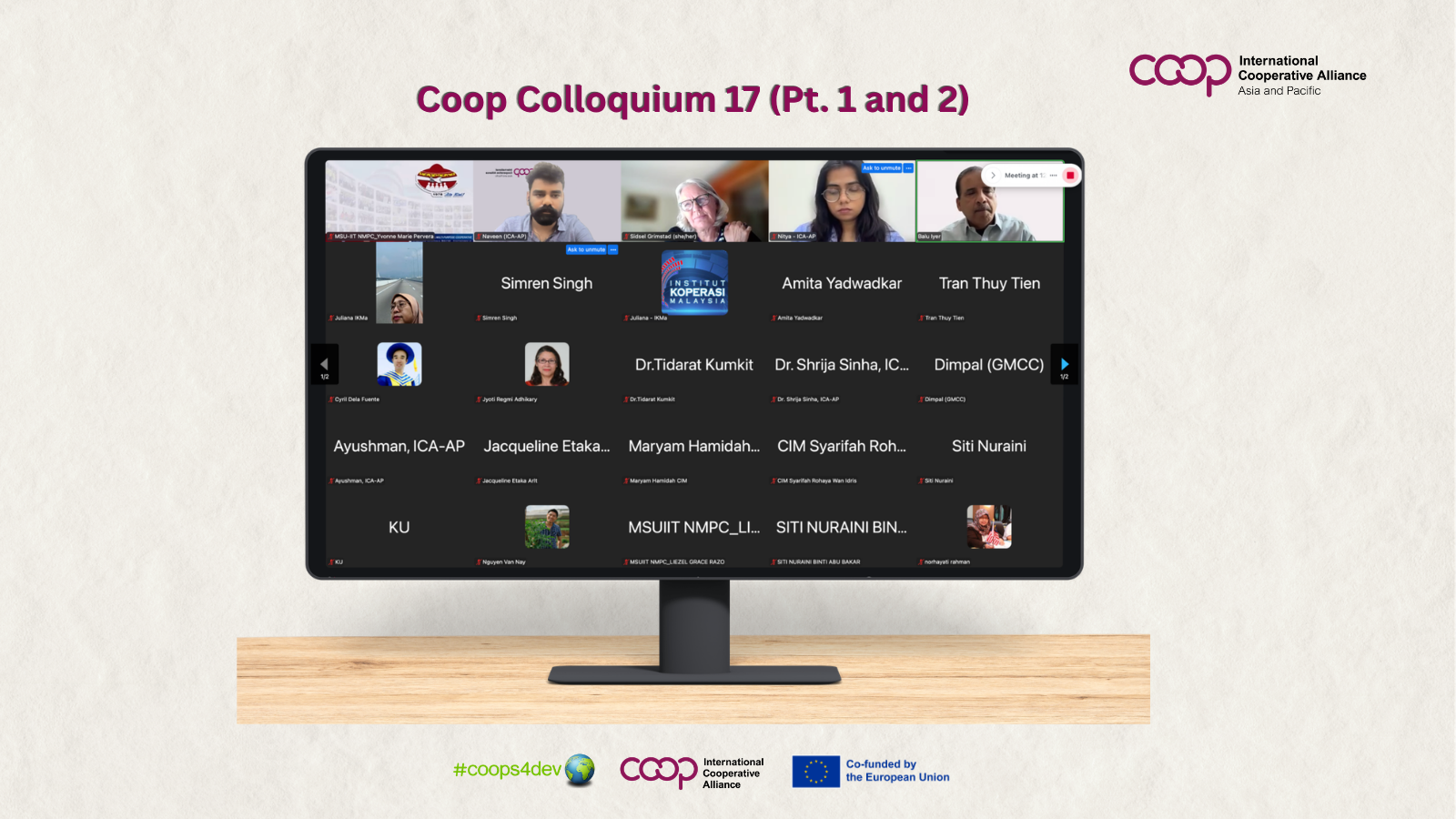
Coop Colloquium 17 Sparks Regional Dialogue on Gender Policies in Cooperatives
The International Cooperative Alliance Asia and Pacific (ICA-AP) Committee on Cooperative Research (CCR), in collaboration with the ICA-AP Committee on Women, successfully organized the 17th edition of the Coop Colloquium as a two-part webinar series on 8 April 2026 and 29 April 2026 under the theme “Review of Gender Policies in Cooperatives in Asia and the Pacific.” Bringing together researchers, policymakers, and cooperative practitioners from across the region, the colloquium created an important platform to examine how far cooperatives in Asia and the Pacific have progressed in making women’s participation more visible, meaningful, and influential.
The two sessions were designed around the findings of a ten-country regional study commissioned by the ICA-AP Women’s Committee, covering experiences from Australia, Jordan, South Korea, the Philippines, Sri Lanka, Fiji, India, Malaysia, Nepal, and Vietnam. While the national contexts varied considerably, one message resonated strongly throughout the colloquium: women are increasingly present in cooperatives as members, workers, and community leaders, yet their participation in governance and decision-making continues to lag behind.
The first session opened with welcome remarks by Ms. Nitya Shukla, followed by an introduction to the study by Ms. Simren Singh and Prof. Rajeshwari C., who outlined the need to look beyond broad policy statements and ask a more practical question: are cooperative institutions truly creating enabling spaces for women to lead?
Presentations from the first five countries offered a revealing mix of progress and persisting gaps. In Australia, women’s representation on the boards of leading cooperatives and mutual enterprises has steadily improved due to strong national workplace equality laws and continued monitoring, showing how accountability can make a difference. In Jordan, women’s cooperative participation is growing through national development efforts, but leadership advancement remains slow in the absence of cooperative-specific legal backing.
The case of South Korea demonstrated that policy alone does not determine outcomes; organizational culture matters equally. While women have gained stronger space in consumer cooperatives, traditional agricultural cooperatives still reflect deeply hierarchical and male-dominated structures. In the Philippines, the existence of Gender and Development Committees and dedicated circulars for cooperatives showed a more systematic approach to gender mainstreaming, although speakers noted that many cooperatives still treat these requirements as compliance obligations rather than internal values. From Sri Lanka, participants learned about the recently introduced National Policy on Gender Integration in Cooperatives, a promising step that now needs stronger implementation and institutional follow-through.
The first session concluded with comments from Prof. H. K. Misra, who highlighted that cooperative values of democracy and equality can only be realized when women are represented not just in numbers but in positions of influence.
The second session resumed on 29 April with a recap by Ms. Simren Singh, before moving into country perspectives from Fiji, India, Malaysia, Nepal, and Vietnam.
In Fiji, speakers reported that women’s participation in cooperatives has been gradually increasing, yet the sector still lacks a dedicated gender policy or enforceable mechanisms for representation. The presentation from India highlighted the emergence of stronger policy recognition for women’s inclusion through recent legislative amendments and the National Cooperative Policy, while also acknowledging that much remains to be done in terms of gender budgeting, workplace equality, and support systems for women-led cooperatives.
The Malaysian experience pointed to the importance of coordinated institutional support, where the regulator, apex body, and training institute are working together to build women’s leadership, even though women still face a visible glass ceiling in mainstream cooperative boards. Nepal stood out for its legally mandated women’s representation in cooperative boards, proving that quotas can significantly improve visibility, though ensuring women’s meaningful influence remains the next challenge. In Vietnam, the discussion showed that despite women’s strong role in membership and workforce participation, leadership opportunities remain limited without dedicated monitoring and stronger accountability systems.
Following the country presentations, Dr. Sidsel Grimstad offered comments and reflections on the significance of continuing this line of research for the cooperative movement. The colloquium concluded with Regional Perspectives and Way Forward for ICA-AP by Mr. Balasubramanian Iyer, who stressed that gender equality in cooperatives must now move from policy intention to measurable action through stronger bylaws, regular reporting, leadership development, and peer learning across countries.
Across both sessions, participants repeatedly returned to a simple but powerful observation: women are already carrying much of the cooperative movement at the grassroots, but they are still not equally present where major decisions are taken. Whether in agriculture, finance, consumer services, or community enterprises, women continue to face barriers created by weak institutional mechanisms, lack of data, social expectations, and the unpaid care burden.
At the same time, the colloquium also offered hope. The country studies showed that where cooperatives combine policy support with practical tools such as leadership quotas, training, gender committees, monitoring systems, and women-focused enterprise models, change begins to happen.
