
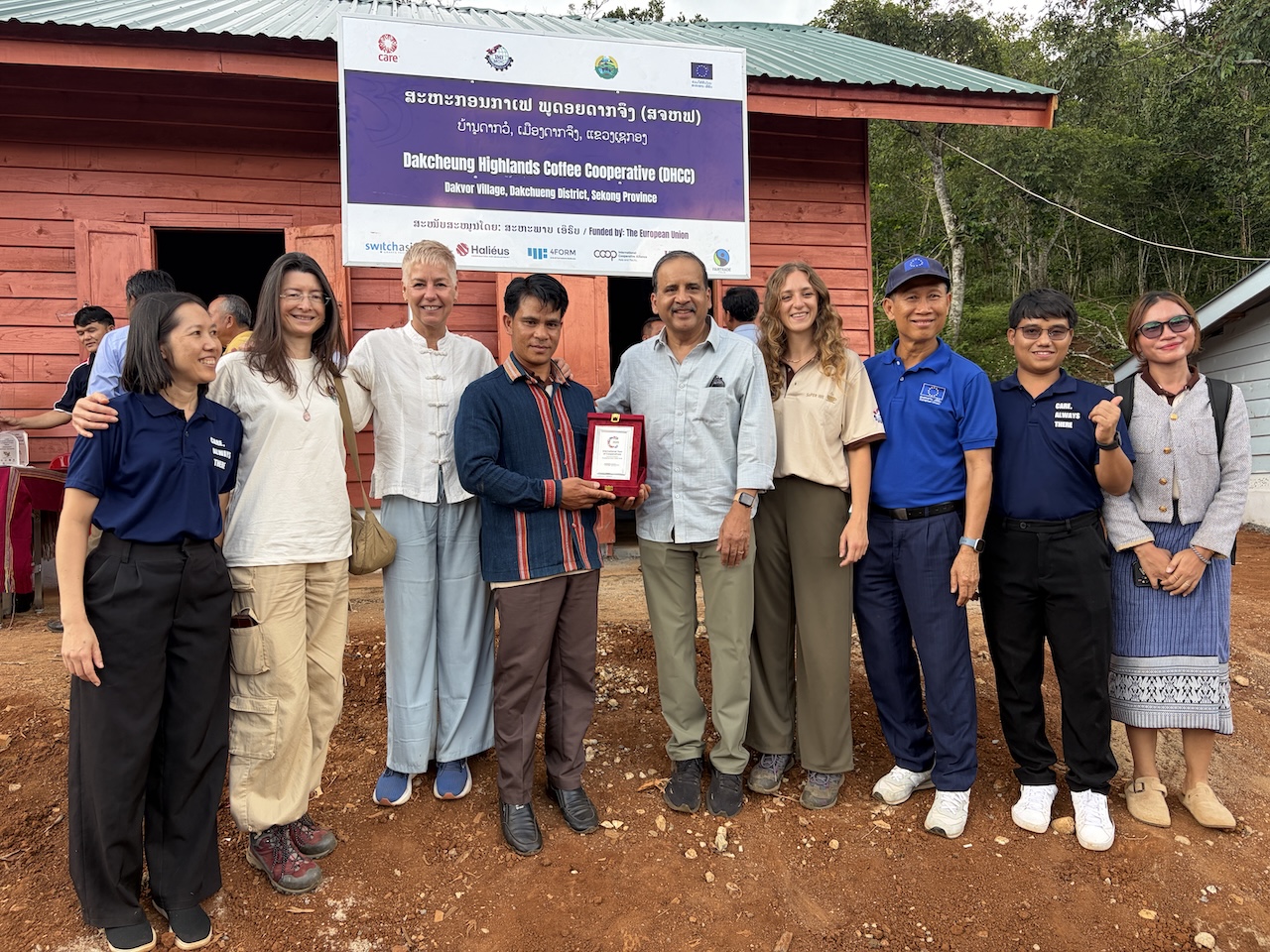
From Project to Cooperative: Building Strong Foundations for Coffee Farmers in Lao PDR
The International Cooperative Alliance – Asia and Pacific (ICA-AP) participated in the closing of the SUPER-WE (Supporting Women’s Economic Resilience and Empowerment) Project in Sekong Province, Lao PDR. Funded by the European Union (EU) and implemented by CARE France, CARE Laos and Haliéus, with support from 4Form and ICA-AP, the project demonstrates how cooperative enterprise can serve as a vehicle for inclusive rural development, women’s empowerment, and sustainable livelihoods.
A key legacy of the project is the establishment of the Dakcheung Highland Coffee Cooperative (DHCC), which brings together 235 members from 15 villages while supporting around 400 households to improve production, processing, and marketing. During the closing mission, ICA-AP joined cooperative members, women farmers, government officials, and project partners to reflect on the progress achieved and the opportunities that lie ahead.
The visit highlighted the transformation taking place among coffee-growing communities. Farmers who once sold red coffee cherries now have a deeper understanding of quality improvement, processing, value addition, and collective marketing. Equally important, they are developing the confidence to work together through a member-owned enterprise.
The cooperative’s business-oriented approach was clearly articulated by Mr. Daoviengphet, President of DHCC, when discussing the cooperative’s future. Rather than focusing on expanding membership, he emphasized that the priority is to ensure members receive better prices for their coffee while building a strong and sustainable business. As he explained, when members experience tangible benefits, others will naturally be encouraged to join the cooperative.
Women’s empowerment has been central to the project’s success. Instead of treating gender as a separate activity, the project integrated women’s participation into cooperative development, climate-resilient agriculture, enterprise development, and livelihood improvement. Approximately 70 percent of the farmers reached through the project are women, who have strengthened both their technical skills and leadership capacities through training and active participation in the cooperative. Ms. Loy Manie, Cashier of DHCC, reflected on this progress, noting that the cooperative has helped members become better organized while training has improved their ability to use technology and manage cooperative operations more effectively. Her experience illustrates how cooperative development extends beyond increasing incomes to building confidence, leadership, and stronger local institutions.
The mission also provided an opportunity to engage with representatives of the Monsoon Wind Power Project, Viet Phuong Group’s bauxite mining operations, the Vice Governor of Sekong Province, and officials from the Departments of Agriculture and Mines. Discussions highlighted the importance of ensuring that major private investments generate meaningful opportunities for local communities while safeguarding environmental sustainability. Effective public policy and active government engagement will continue to play an essential role in ensuring that economic development delivers long-term benefits for rural communities.
Beyond the project itself, the visit offered valuable insights into the broader evolution of the cooperative movement in Lao PDR. Meetings with Ms. Vimolath Vannavong of DGRV, Thongchanh Xaiyavong of the Lao Agricultural Cooperatives Federation (LACF), and Bouathong Keoar from the Department of Agricultural Extension and Cooperatives underscored the growing emphasis on building not only successful cooperatives but also strong support institutions.
The recent establishment of LACF represents an important step in strengthening the country’s cooperative ecosystem. As the national apex body for agricultural cooperatives, the federation aims to strengthen cooperative capacity, improve market access, and create greater opportunities for products such as coffee, rice, and other agricultural commodities. Alongside the enactment of Lao PDR’s new cooperative legislation in 2024, these developments provide a stronger institutional foundation for the future growth of the cooperative sector.
Another encouraging feature of the Lao experience is the strong collaboration among cooperative development organisations. Government agencies, DGRV, CARE, Haliéus, Helvetas, ICA-AP, and other partners are contributing complementary expertise, demonstrating the value of coordinated partnerships in building resilient cooperative enterprises.
ICA-AP has been pleased to support this journey through Training of Trainers programmes, participation in regional learning exchanges, and the sharing of cooperative experiences from across the Asia-Pacific region. Such exchanges help connect emerging cooperatives with practical knowledge and successful models from other countries while reinforcing the principles of democratic governance, member participation, and sustainable enterprise development.
While the registration of DHCC marks an important achievement, it is only the beginning of the cooperative’s journey. The long-term success of the cooperative will depend on maintaining active member participation, strengthening financial management, building lasting relationships with buyers, continually improving coffee quality and value addition, and developing strong partnerships with business support institutions. Organisations such as LACF and the Lao Coffee Association have important roles to play in providing business development services, facilitating market linkages, and supporting cooperative growth beyond the life of donor-funded projects.
ICA-AP congratulates the members of the Dakcheung Highland Coffee Cooperative and extends its appreciation to the European Union, CARE France, CARE Laos, Haliéus, 4Form, DGRV, government partners, and all stakeholders who contributed to this collaborative effort. As Lao PDR continues to strengthen its cooperative ecosystem, initiatives such as DHCC demonstrate that lasting development begins with strong institutions, committed members, and communities working together to create shared prosperity.