
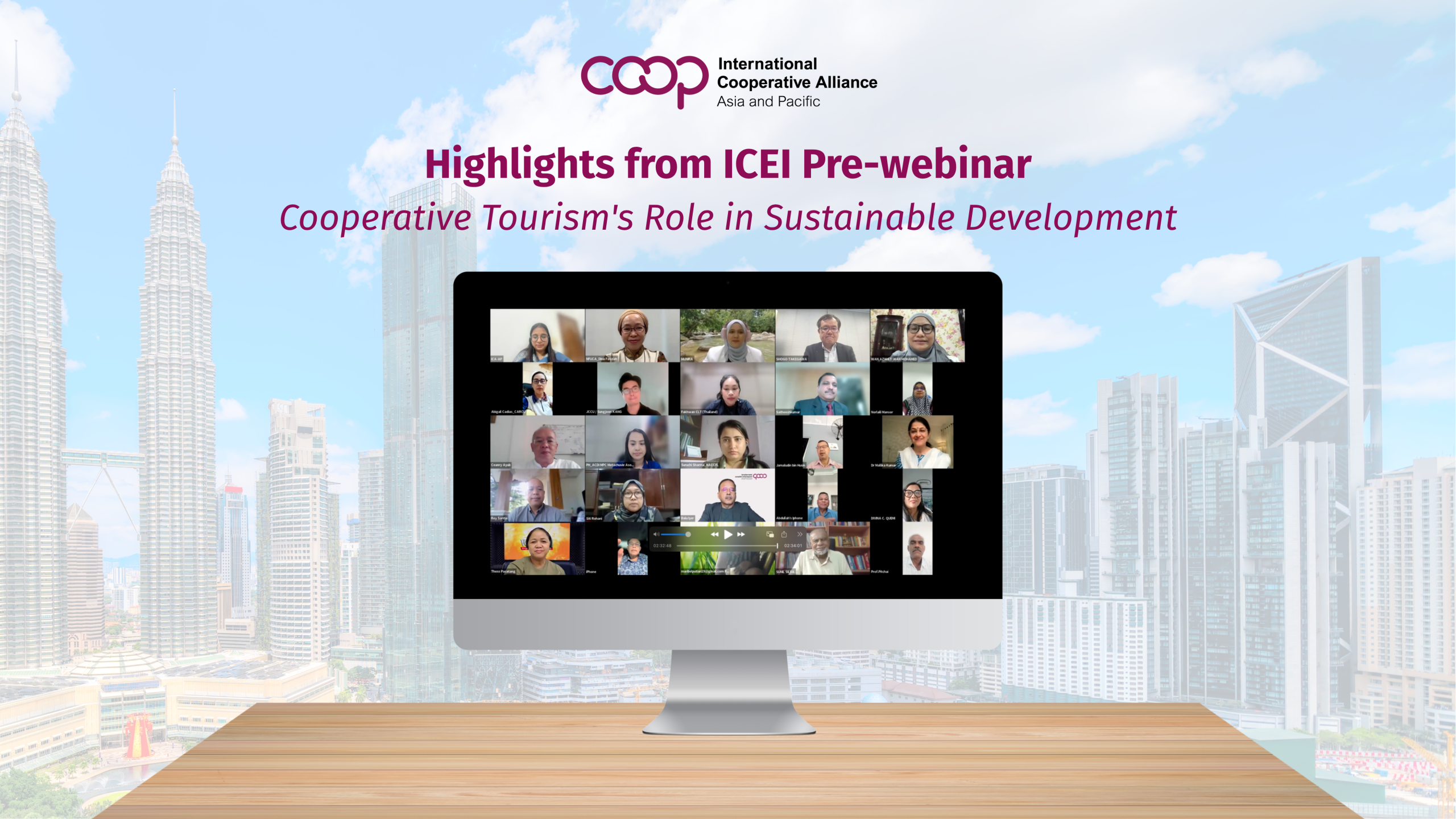
Webinar Highlights: Cooperative Tourism’s Role in Sustainable Development
The ICA-AP Committee on Cooperatives in Educational Institutions (ICEI), in collaboration with the ICA-AP Committee on Trade & Business, successfully organised a Pre-Event Webinar on “Coop Tourism – Unlocking Business Potential” on 15 May 2026. The virtual event served as the formal launch of the forthcoming ICA-AP Regional Immersion Programme on Cooperative Tourism, scheduled to be held in Pahang and Kuala Lumpur, Malaysia, from 22–26 July 2026.
The webinar brought together cooperative leaders, practitioners, educators, tourism professionals, and representatives of apex cooperative organisations from across the Asia-Pacific region to explore the growing role of cooperative tourism as a viable business model that promotes inclusive growth, cultural preservation, environmental sustainability, and community empowerment.
Welcoming the participants, the moderators outlined the objectives of the webinar and the upcoming immersion programme. Setting the context for the discussions, Prof. Shogo Takegawa, Chairperson, ICEI, highlighted the transformative potential of cooperative tourism in addressing contemporary socio-economic challenges. Referring to the theme, he emphasized that tourism, when rooted in cooperative values and principles, can create sustainable livelihood opportunities while ensuring that economic benefits remain within local communities.
The first technical session was delivered by Mr. Satheesh Kumar N., Manager (Business Development), Kerala Arts & Crafts Village (KACV), an initiative managed by the Uralungal Labour Contract Cooperative Society (ULCCS), India. Presenting the Indian perspective on cooperative tourism, he highlighted successful community-based tourism models from across the country, including Hodka Village in Gujarat, Jambhrun Trails in Maharashtra, and Kerala’s internationally acclaimed Responsible Tourism Mission.
Drawing on ULCCS’s experience, Mr. Satheesh discussed the role of the Kerala Arts & Crafts Village (KACV) in promoting traditional crafts, performing arts, and cultural heritage while creating sustainable livelihood opportunities for local communities. The Village serves as a hub for live craft-making and traditional art forms, including Kalarippayattu, and currently engages more than 50 artisans and over 250 performing artists in various cultural productions. Across its tourism campuses, ULCCS employs more than 250 individuals, the majority of whom are women from neighbouring rural communities, making the initiative a notable model of women’s empowerment and rural economic development. He further highlighted how the cooperative enables artisans and handloom weavers to market their products directly to visitors without intermediaries, ensuring fair returns to producers while offering tourists authentic cultural experiences. Through training programmes, workshops, exhibitions, and awareness campaigns, the initiative has positively impacted the livelihoods of more than 5,000 artisan and handloom-weaver families.
Mr. Asanka Thilakarathna, CEO and General Secretary of the National Cooperative Council of Sri Lanka (NCCSL), shared his organisation’s approach to sustainable tourism through cooperative institutions. He explained that NCCSL frames cooperative tourism not as a commercial activity but as a value-driven service centred on member welfare, international networking, and professional exchange. Through its Foreign Tourism Programmes, NCCSL facilitates international exposure visits for cooperative members and leaders to learn from successful cooperative models in countries such as Malaysia, India, and Thailand. Mr. Thilakarathna also presented NCCSL’s proposal to establish a dedicated Cooperative Tourism Promotion Bureau under the NCCSL to strengthen and promote cooperative-based tourism across the country.
Dr. Divina Quemi, Chief Executive Officer of the Nueva Segovia Consortium of Cooperatives (NSCC), Philippines, highlighted tourism’s growing contribution to the Philippine economy and described how NSCC leveraged its strategic location in Vigan City, a UNESCO World Heritage Site, to establish a range of tourism enterprises including hotels, restaurants, agri-tourism facilities, training centres, and conference venues. She elaborated on NSCC’s integrated cooperative tourism model, which is built around three interconnected components — Coop Tourism, Agri-Tourism, and Local Tourism — and emphasised that this approach enables tourism to serve not only as a source of revenue but also as a platform for education, networking, community engagement, and cooperative development.
Representing the Malaysian perspective, Mrs. Munirah Binti Mustapha, Manager of Chemerkaw Resort in Kampung Peruas, presented community-based tourism initiatives developed under KOPERAD and Desa Lestari. Using Kampung Peruas as a case study, she demonstrated how community-driven tourism can preserve local identity, promote rural entrepreneurship, and generate economic opportunities while maintaining environmental and cultural sustainability. Her presentation underscored the importance of cooperative participation in ensuring that tourism development remains inclusive and beneficial to local communities.
Dato’ Kamaruddin Ismail, Vice-Chairperson of ICA-AP ICEI, then introduced the Regional Immersion Programme, providing participants with an overview of its objectives, structure, and learning opportunities. This was followed by an interactive discussion in which participants engaged with speakers and exchanged perspectives on cooperative tourism initiatives across the region. Mr. Balu Iyer, Regional Director of ICA-AP, highlighted the growing importance of cooperative tourism in promoting sustainable development and regional collaboration. Datuk Seri Dr. Hj. Abdul Fattah bin Hj. Abdullah, President of ANGKASA and Chairperson of the ICA-AP Committee on Trade & Business, closed the webinar by thanking the speakers, participants, and organisers for their contributions, and encouraged continued cooperation to advance cooperative tourism across the Asia-Pacific region.
The webinar successfully achieved its objective of building awareness of the Regional Immersion Programme while showcasing innovative and inspiring cooperative tourism practices from across the region.
Watch the webinar recording: here